
A Curaçao licence, the Norwegian market
TrustDice: the licence holds, three fields stand empty
TrustDice prints 8048/JAZ on its own pages, while the registers answer with two other numbers and 8000 games sit in the library — but 3 of the 5 clauses in the comparison stand without figures.
What TrustDice is
The review starts where the terms are silent. TrustDice has been operating since 2018. The number the operator prints on its own pages is 8048/JAZ, in the old Curaçao sub-licence format — it does not exist in any authority register and can only be confirmed with the master licence holder. On 26 August 2026 the certificate portal of the Curaçao Gaming Authority answered for trustdice.win with a completely different number, OGL/2024/664/0280, on Satoshi Gaming Group N.V., company number 151832, issued 16 July 2024 and with the status Active. The Anjouan register answered the same day with ALSI-202605020-FI1 on Satoshi Labs Ltd, valid until 14 May 2027. The table carries the registered number; the number from the operator's own pages appears here, alongside, because it is a different piece of information and not a fresher version of the same one. The site targets Norway and supports kroner alongside 20 cryptocurrencies; BTC and ETH stand at the top, along with EOS, followed by USDT, TRX and LTC. The game library counts 8000 titles from 50 studios, with a sportsbook and provably fair games. Signing up requires only an email address.
Signing up by email lowers the barrier in, but says nothing about the barrier out. That the cashier takes 20 currencies is practical for anyone who already holds crypto; it still says little about how straightforward a withdrawal will be. Breadth of games is no substitute for clear terms either, and for a player in Norway the latter is usually more decisive. The methodology explains how the two are weighed against each other.
For players in Norway the regulatory frame is a different one. Lotteritilsynet regulates the market in Norway, and the Lottery Act and the Gambling Act set the limits. TrustDice in Norway is therefore an offshore offer with a Curaçao licence, not a casino licensed in Norway. A crypto casino can hold a verified licence in Curaçao and still stand outside Norwegian complaint schemes. That is a difference that matters in a disagreement over a withdrawal or a bonus.
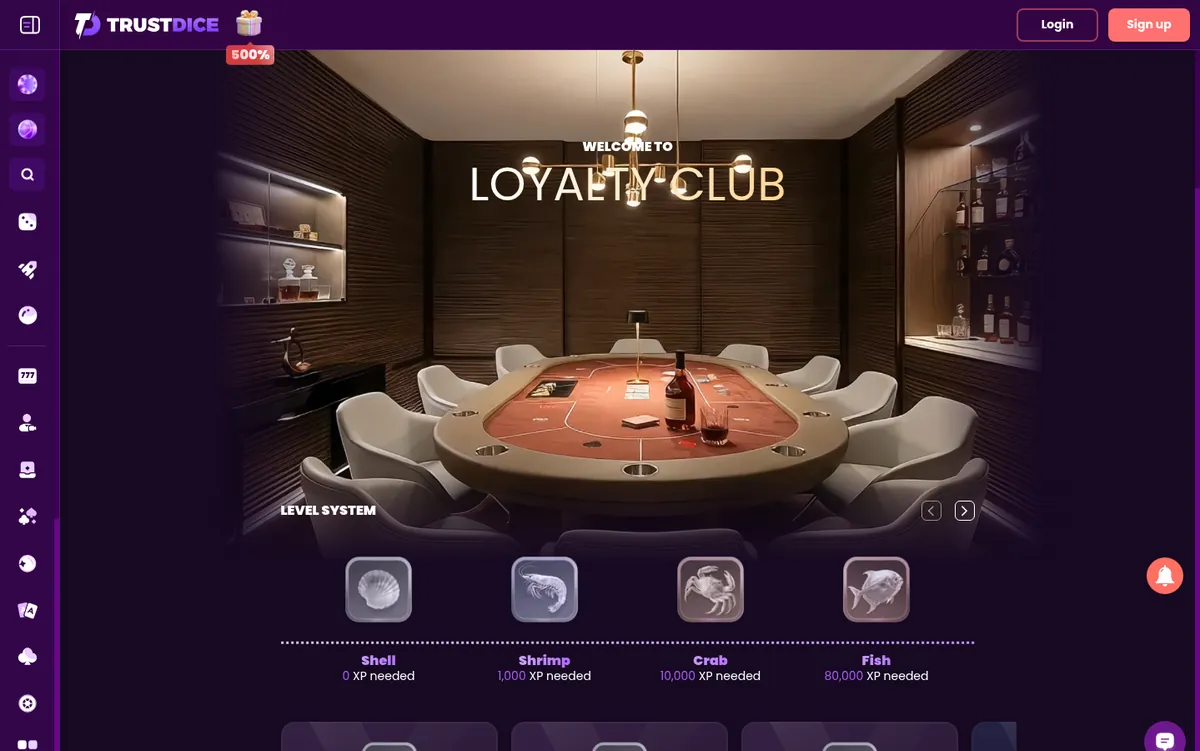
Loyalty tiers are a wagering ladder, not a discount. Read what has to be staked to reach a tier before you treat the rakeback at the top as money back.
The bonus and the unpublished requirement
The welcome offer is 100 per cent plus 25 free spins. Those are concrete figures, but on their own they say little. The wagering requirement is stated as varying rather than as a single fixed figure, and without a multiplier it is impossible to calculate how much of the deposit and bonus has to be played through before a withdrawal becomes possible. A bonus is a condition, not a gift. The 25 free spins have the same problem: the winnings from them may be locked or free, and which of the two applies is settled by the requirement that is missing. The marketing states the percentage, which is half the arithmetic.
Anyone who reads the bonus terms before depositing will quickly see what is missing here. Compared with a casino without a wagering requirement the difference becomes clear: an offer with no published requirement gives the operator more room and the player less.
Withdrawals, documentation and limits
The operator states no threshold for identification: documents may be demanded before any payout, at the company's own discretion. The withdrawal cap stands empty too. A player therefore knows neither whether a particular amount meets a cap, a document demand or both.
Three minutes at the short end sounds precise, but it guarantees nothing about when the money is in the account. The clock only starts once any document check has been considered, and how long that consideration takes appears nowhere. This of course means many withdrawals go straight through; it also means the terms give too thin a basis for planning one of them.
For anyone looking for fast payouts this is precisely the decisive distinction: how quickly the system handles a payment is one thing, how quickly the player gets it approved is another. With both unpublished, all that remains is to read the terms again for every payout.
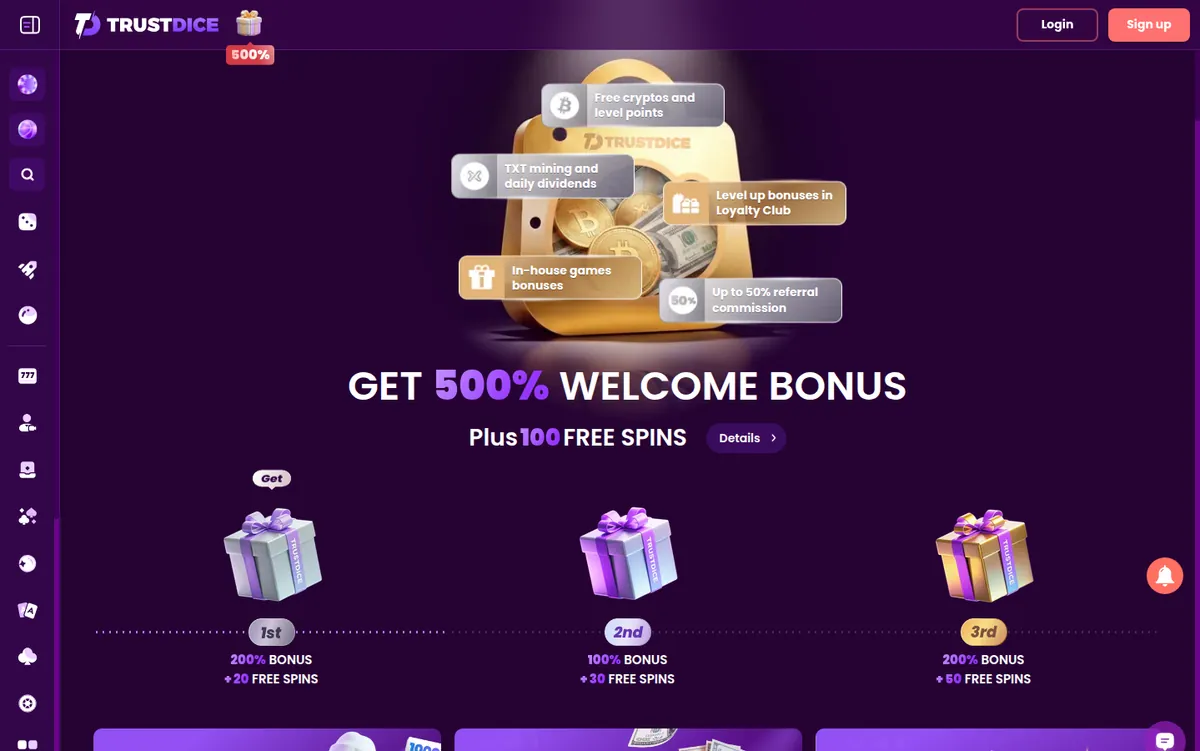
The headline percentage is the easy part. What decides whether a bonus is worth taking is the wagering multiplier and the maximum stake while the bonus is active, and both sit further down the page than the number in the banner.
Is TrustDice safe?
The question has more than one answer. Two authority registers answer for TrustDice with a valid number each, and that is better than a licence that cannot be looked up — two of the ten operators in the comparison return no match in any register. Note at the same time that the two entries stand on two different companies, and that the number the operator prints itself is neither of them. But safety is also about written terms, and here three figures stand empty: the wagering requirement, the withdrawal cap and the threshold for identification. A site can be technically solid and still have terms that make a withdrawal hard to foresee.
For players in Norway the rules come on top: Lotteritilsynet supervises under the Lottery Act and the Gambling Act, and TrustDice sits outside that regime. Anyone who wants to know more about legality should read the legislation rather than the marketing. The list of excluded countries has not been confirmed one by one here either.
What the review weighs
This page ranks TrustDice by what is written down, not by how good the product feels. Three empty fields are three reasons for restraint. That makes neither the requirements unreasonable nor the operator dishonest; it makes them impossible to plan around. Most comparisons stop at the game selection and the welcome percentage. This one stops where the terms fall silent, and that is usually where the money ends up sitting.